Using Segment Data to Document Your Ancestors

Where do you go after you’ve identified a genetic network of matches and figured out how they match you? You document what you’ve learned. One way to document what you’ve learned is by capturing the segment data, the actual places where you and your match share DNA. The news that MyHeritage is going to stop allowing raw DNA uploads is a disappointment since that has been my preferred place for downloading segment data. Leah Larkin explains the possible reasons for this change of process at MyHeritage here, and they certainly make sense. The ease of transferring a DNA data file from Ancestry to MyHeritage was a motivation for many to use MyHeritage. In the future, customers will need to purchase a MyHeritage DNA test to be represented in the database. Two other companies, FamilyTreeDNA and Living DNA still accept uploads and have a chromosome browser, as does the third party website GEDmatch. 23andMe had a chromosome browser before the data breach in 2023. With new owners buying the bankrupt company, the future of 23andMe’s database and functionality is anyone’s guess.

As a reminder of the value of segment data, I have an example from my own research that might entice you to make sure your DNA is on a site with a chromosome browser and that you are familiar with the amazing things you can do at DNA Painter.

In a prior post I wrote about the lure of small DNA segments and you can find another example there.

To dive deep into segment data, the person to know is Jim Bartlett. He writes extensively about segments on his blog, Segmentology, and entries like this one are good places to start. Roberta Estes has organized her information about segment triangulation (when three people all share the same segment) here. Kitty Cooper is another blogger with extensive experience with segment data.

Here’s a DNA Painting of my maternal chromosome 14. The entire chromosome has been painted with the DNA from my two maternal great-grandparent couples, one in pink and one in yellow. You can see where the DNA from my mother crossed over from her paternal side (yellow) to the maternal side (pink). For more about recombination, see this video.

Screenshot from a privatized chromsome painting of Chromosome 14 at DNA Painter

In order to create the DNA painting, I downloaded the segment data from different websites (you will see them labeled: 23andMe and MyHeritage for this particular chromosome) and then uploaded the segment data to DNA Painter. I assigned each segment an ancestor and a corresponding colour. The pink represents my maternal-maternal great-grandparents, Malcolm Argul Pike and Martha Edna (Greer) Pike. I labelled the matches with the relationship (1C1R for first cousin once removed, etc.) These are my cousins KSGM, ADJ, BH, and PP. The yellow segment is a 1C1R who descends from my maternal-paternal great-grandparents, Winfield Scott Johnson and Lillie May Key.

The diagram below of the maternal side of my family tree has been colour-coded to match the DNA painting above.
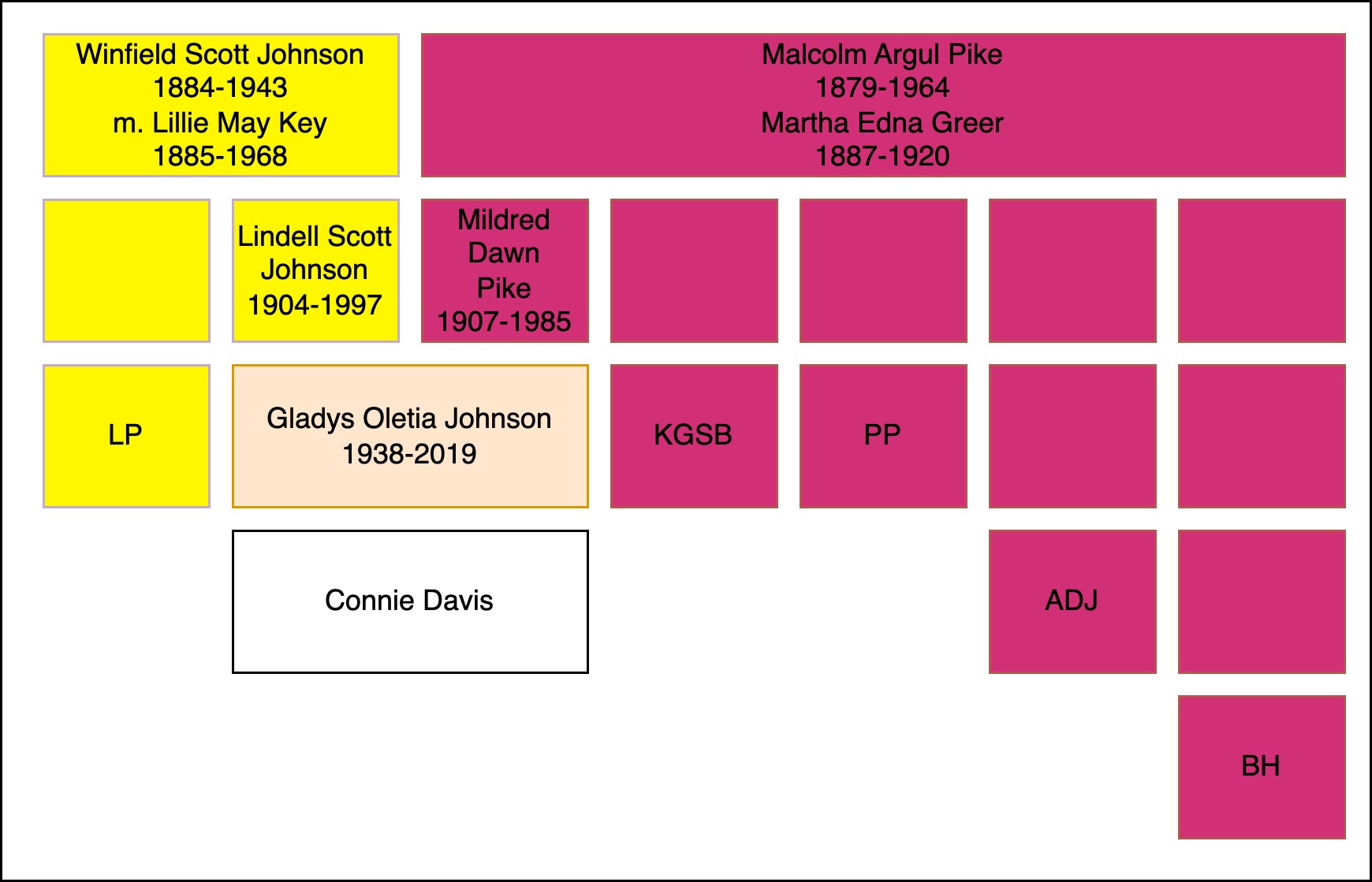
Family diagram showing my maternal great-grandparents and DNA matches from each of them.

I have now documented my great-grandparents for my maternal chromosome 14. I’m creating a catalogued library of my DNA data. Any matches with segment data can easily be identified by great-grandparent. And as a reminder – matches to great-grandparents are special. You always receive DNA from your great-grandparents!

I hope this example will inspire you to make sure your own DNA is at a website or websites where you can access a chromosome browser and that you have other cousins who do the same. In the long run, this type of analysis will help us all identify our ancestors.

The year 2022 in blogging

It’s that time of year when people look back to reflect and look forward to wonder. I began the year 2022 with an internal pledge to blog regularly. I set up an every-other-week reminder within my task-management software, Omnifocus for Mac (based on Getting Things Done by David Allen). I exceeded my goal and published 33 blogs here in 2022. I focused on the things I care about:

  • History and Identity
  • Impacts
  • Genetic Genealogy
  • Documentary Research
  • My Family History

In my first post of 2022 I wrote:

I study family history because it forms the foundation of who I am and how I think and act. An understanding of where I come from gives me strength and gives me pause. I have discovered inspiring stories and tragic ones. I have marvelled at the steps my ancestors took (literally) that led to my presence and wondered at their inhumanity. Curiosity and the quest for meaning shape my journey. And sometimes that meaning requires action. The action can be reporting on what I’ve discovered or taking steps to address historical wrongs.

The blog that most clearly captures that theme is this one from February. I expect to continue uncovering and facing my family’s past and sharing it here and on WikiTree.

Throughout the year, there are blog posts telling about new tools, reminders about tried-and-true research approaches, and touching stories encountered during research.

In September I embarked on several journeys. One I wrote about here. I volunteered as a peer group leader for Family Locket’s Research Like a Pro Study Group. Genealogy is good for your brain (another theme of my first blog entry of 2022), and one way I do that is through continuing education. As a peer group leader, I read many other people’s research as well as working on my own. And as is more common than not, it will take several phases of research until I consider the project “done.” (Done in a genealogical sense, meaning that new evidence could lead to a reassessment and new conclusions.)

Another journey took me on a new path. I was invited to join the team at Your DNA Guide. This launched an intense period of getting to know all the amazing offerings at Your DNA Guide and figuring out how I could support the mission: “Strengthening personal identity so people can connect to their families and communities.” I’ve contributed a couple of blog entries (you can find those here and here.) I’ve started coaching students in Your DNA Guide courses. And I’ve taken on project management for the Academy courses. It’s an exciting time in a growing company whose mission I care deeply about.

A third journey is one of friendship. A genealogy joy of 2022 is an ongoing relationship with two genetic genealogy buddies. We have plans. We have dreams. And we have real lives. Some of our plans may come to be, who knows?

So what does all this mean for 2023? I think I’m going to pause that reminder on blogging. I want to write when I feel moved to write. One recent blog was inspired by a new client who is enthusiastic about learning genealogy to face their own family’s history. I continue to be drawn to and repelled by my family’s contribution to colonization and slavery. I expect to continue to share what I learn about that here and on WikiTree. And when new and exciting things come around, I might be inspired to write. But as a task, I don’t think blogging serves me well.

Thanks for being here. And doing what feeds your soul.

FANs and WikiTree

This week, the WikiTree Family News (an optional newsletter for WikiTreers) highlighted a blog by Kathleen Hill Tesluk with the following quote:

Elizabeth Shown Mills reminds us to study in depth each friend, associate, or neighbor our ancestor interacted with in order to learn more about the context of their lives and break down brick walls. WikiTree is the perfect platform to record this information in a convenient place. … it combines the power of analytical narrative with the visualization of a tree.

Kathleen Hill Tesluck, “WikiTree and the FAN Principle,” Voices from a distant past (https://voicesfromadistantpast.blogspot.com/2022/08/wikitree-and-fan-principle.html : accessed 9 August 2022).

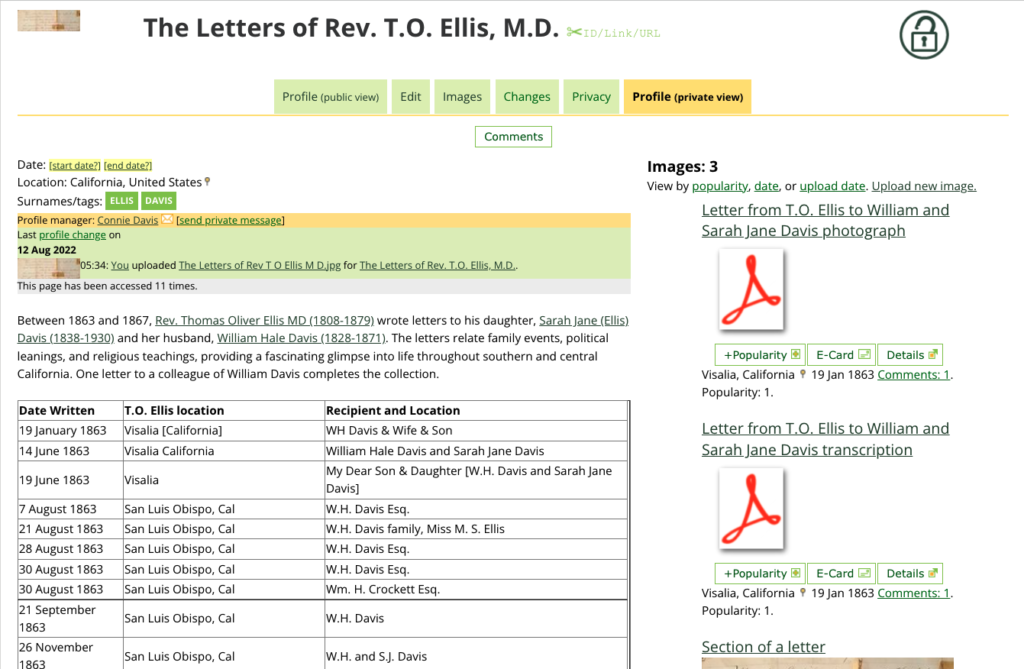
That had my attention right away. I recently started a Free Space Profile (FSP) on WikiTree to share the letters my 3x-great grandfather wrote in the middle 1800’s. Throughout the letters he mentions neighbors and colleagues, particularly from his two chosen fields of endeavour, medicine and religion. (He also farmed, and I suspect his wife Elizabeth kept that going!) As part of my certificate in the University of Washington’s Genealogy and Family History Program, I researched the letters and created a spreadsheet of everyone mentioned and did preliminary research on them. The final result is available here. (Note: This project was written when the Genealogical Proof Standard and Elizabeth Shown Mill’s amazing contributions around citation and evidence were just beginning to take hold.)

Uploading the letters to the FSP will take time, since I need to adjust the images of the letters, turn them into PDFs and review my transcriptions. Creating the FSP gave me the opportunity to learn some new formatting techniques on WikiTree and I am grateful for the opportunity. And thanks to Kathleen’s blog, I can begin to link the people in the letters or his biography to other WikiTree profiles. I connected the first one today, Col. Thomas Baker, who was a California Senator.

I am simultaneously working on upgrading Thomas’ WikiTree profile to Level 3. For more about WikiTree biography standards, check out this post from the Profile Improvement Team.

The power of WikiTree to capture information, share knowledge, and connect people continues to grow.