DNA testing companies routinely update their Biogeographical Ancestry (BGA), or ethnicity, results. The term BGA better describes what these results actually do: they describe the origins of ancestral groups in a place at a distant time. For a deep dive into how these estimates were derived for Ancestry in 2026, see the excellent article by Yvonne Fenster at Family Locket. The updates often differ from prior results and Yvonne deftly explains why. A brief incomplete summary: Changes are due to increased size of the reference groups (which determine patterns in DNA that are associated with different groups as they migrated around or out of Africa), advances in the science of understanding human migration, and updated techniques for analysis.
23andMe, MyHeritage, and Ancestry all updated their BGA results this year. At the first DNA Conference I attended in 2017, some speakers dismissed BGA as useless in genealogy and only good for marketing and party conversation. That answer has evolved over time. The addition of genetic groups (MyHeritage) and Ancestral Journeys (Ancestry) which follow migratory patterns in a more recent time frame can provide key information, especially in less known branches of the tree. Instead of limited to information provided in maps and charts, Ancestry, 23andMe, and FamilyTreeDNA show a DNA painting of where BGA segments are located on each chromosome. This information can be downloaded from Ancestry and FamilyTreeDNA. (See below for information on how to do this.) The ability to combine BGA chromosome segment data with ancestral segment data (segments that can be linked to specific ancestors through shared matches and documentary research), means genealogists can use BGA to answer genealogical questions. One example of using this approach is a project I am working on with many collaborating cousins, the William and Ann Cole Ancestry Project. The project has two goals:
- to identify the parents of Ann, who married William Cole. William and Ann (also known as Sarah or Fanny) were enumerated together in Benton County, Tennessee from 1850 through 1880.
- to determine the source of Indigenous (Native American) DNA in the descendants of William and Ann.
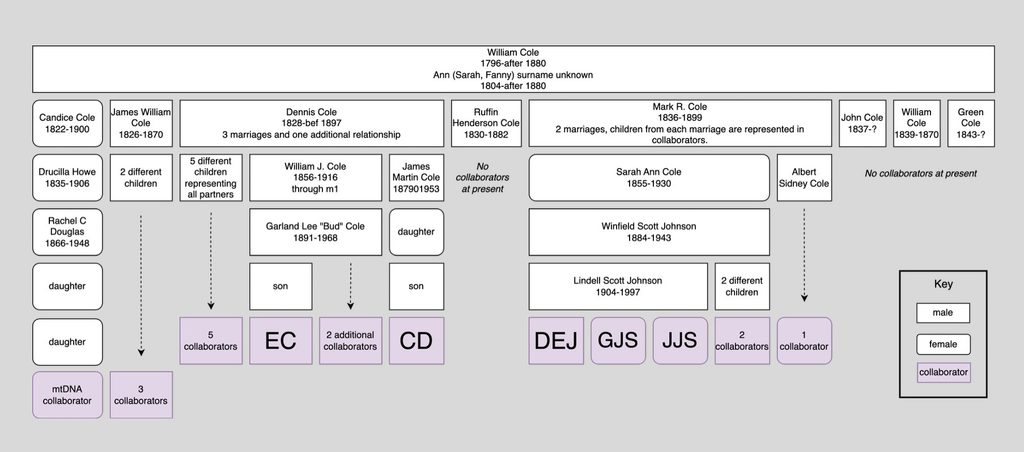
This blog entry focuses on the second goal, identifying the source of Indigenous DNA in descendants. First let’s tackle the question of direct line Indigenous Ancestry for William and Ann. The diagram below depicts the relationships of the current collaborators on the project, with the initials of the key collaborators shown.
YDNA and mtDNA Results for the Cole project
Quick reminder: YDNA traces the direct male line back through the generations and can also provide BGA information through specific haplogroups known to share the same migration pattern around or out of Africa. mtDNA does the same through the direct female line. For an overview of YDNA and mtDNA, see FamilyTreeDNA Y-DNA testing information and mtDNA testing information. Roberta Estes has written a comprehensive book on using FamilyTreeDNA.
We know that William Cole did not have Indigenous ancestry in his direct paternal line because EC, a Cole YDNA tester, does not have an Indigenous YDNA haplogroup (see EC in the diagram).
His wife Ann does not have Indigenous ancestry in her direct maternal line because a Cole descendant (labelled mtDNA collaborator on the diagram) does not have an mtDNA Indigenous haplogroup.
Future work may identify additional opportunities to use YDNA and mtDNA testing.
Comparison of 2026 Ancestral Region estimates with prior estimates
When Ancestry announced its update, I wondered how the results might have changed for the Cole project. Eighteen collaborators have shared their autosomal Ancestry DNA results with me. Five of the eighteen collaborators (initials shown on the figure above) had Indigenous American DNA prior to 2026. Much has changed with the update.
None of those without Indigenous DNA prior to 2026 now have it. Of those who had Indigenous ancestry prior to 2026:
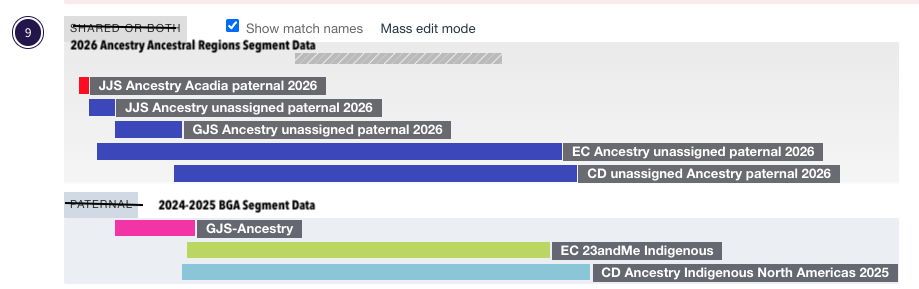
- DEJ (my uncle) continues to have 3 segments that were labelled Indigenous Americas – North prior to 2026 and are now labelled Indigenous Americas – Atlantic Northeast (Canada & US). This new label provides the opportunity to compare with DNA matches with more specificity than before. The 2026 segments are slightly smaller than before. There is an additional small segment (5.3 cM) that is also labelled Indigenous Americas – Atlantic Northeast. DEJ has Indigenous segments on Chromosomes 3, 4, 6, and 12.
- JJS (my aunt) had Indigenous Americas – North on Chromsomes 3 and 6 in the same locations as my uncle DEJ in previous years. DEJ still has them but JJS now has none. JJS does have “unassigned” paternal segments in these locations. Ancestry knows JJS and DEJ are siblings. I’m not sure why Ancestry is unable to label JJS’s segments the same as DEJ. My interpretation is that the algorithms that determine relationships are not linked to the BGA algorithms that provide the labels.
- GJS (my mother) had an Indigenous Americas – North segment on the paternal (Cole) side of her tree on Chromosome 9 and now has none. It is now an “unassigned” paternal segment. Chromosome 3 continues to be a puzzle. On Chromosome 3, GJS has an area of overlap (8.7 cM, also visible on GEDmatch) with her two siblings DEJ and JJS. It is unassigned for GJS, but assigned Indigenous Americas – Atlantic Northeast for her sibling, DEJ. It seems like this segment could be assigned Indigenous for her as well as JJS.

- EC is a fourth cousin of DEJ, JJS, and GJS, sharing the same ancestral couple, William and Ann Cole (refer to the diagram above for a descendancy diagram). EC had an Indigenous segment on Chromosome 9 from 23and Me in past years which is unassigned on Ancestry in 2026.
- CD is also a fourth cousin of DEJ, JJS, and GJS, and is a third cousin of EC. In 2025, CD had a segment at Ancestry labelled Indigenous Americas – North on Chromosome 9 which was almost totally shared with EC. They also share this segment at MyHeritage. Again, this segment is now labelled unassigned for CD as well as EC.
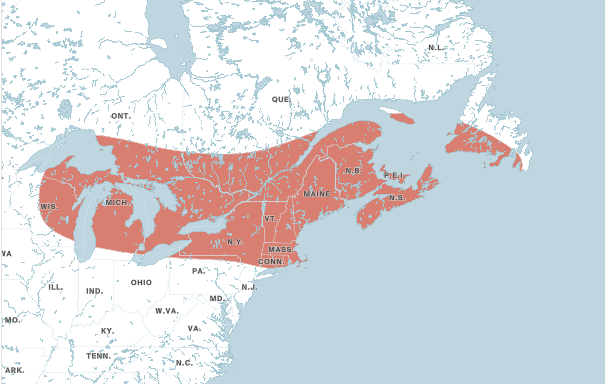
Ancestry’s next update will be interesting. Perhaps more of the unassigned segments will be assigned. It is challenging to build reference groups for the Indigenous Americas due to understandably reluctant participation from these communities. In 2026, Ancestry also initiated two new groups – Quebec and Acadia. I have not been able to find a good description of how these groups were determined and they are currently not listed as Indigenous Americas. Ancestry’s White Paper says the Ancestral Regions represent 1000 years ago. Leif Erikson may have landed in Newfoundland around 1000 C.E. but this time period should not represent European DNA in North America. Many of the Cole project kits I manage at Ancestry have small (1-3%) Quebec or Acadian. When looking at the maps provided at Ancestry, these regions overlap the Indigenous Americas – Atlantic Northeast (USA & Canada). I would love to know more about the science behind these three groups.
How might these segments help the Cole project?
I started by identifying Cole matches with Indigenous BGA segments. My next step is to identify which ancestors can be assigned to these segments by finding shared matches. Genetic genealogy is always paired with documentary research. Documentary research is being done simultaneously to learn as much as possible about William Cole and his FAN club. This may yield surnames of interest to watch for in trees of DNA matches. The DNA research can also be done the other way around: identify ancestral segments that can be assigned to William and Ann, and then see if those are noted to be of Indigenous Ancestry.
N.B.: It is a leap from the BGA segments to an ancestral couple! At this point in the project, I would be much happier if I had more triangulated segments from a wider variety of Cole descendants. Until more descendants are in the databases that share segment data, I am working with less data than I would like to. I need to be able to demonstrate that I have “walked the segments back” to the correct ancestors. (See an example at the end of this blog entry with my Davis and Ellis cousins.)
If cousins can be identified in the generation prior to William and Ann, it may be possible to further isolate the source of the Indigenous DNA. Research at MyHeritage identified an additional match to EC and CD on Chromosome 9, meaning we now have a triangulated group (three people matching the same segment). This match has a Mary Cole in their tree with no known parents. Mary Cole is about the same generation as William Cole and was reportedly born in South Carolina, the same birthplace as William’s wife Ann. It’s far too early to come to any conclusion about a relationship, but it is definitely intriguing. The Cole name could be wrong, Cole cold be a coincidence and the shared ancestry might not be a Cole since other lines of the match’s tree are incomplete. It’s time to complete the match’s tree back to the generation of Mary Cole and beyond.
I have an additional challenge with the Cole descendants. Many of them lived in Benton County, Tennessee from the early 1800s many remain there to this day. In one case, my mother and her siblings have one match with three known Benton County relationships – two are through the Cole family. I am concentrating on identifying matches who left Benton County and are not known to have secondary (or tertiary or more) relationships. With enough testers, it is more likely that ancestral segments can be identified correctly.
Documentary evidence of Indigenous ancestry will be hard to find. We may need to be content with isolating the branch through use of additional YDNA and mtDNA results.
This project may not be do-able right now due to lack of matches with segment data, lack of documentation, and lack of accurate BGA information. Only time will tell.
Jonny Perl has written an excellent blog about the update and his experience using Ancestral Region segments in a search for an ancestor.
Steps with links to additional resources
Step 1: Learn how to do chromosome painting at DNA Painter.
None of this would be possible without the amazing tools at DNA Painter. Jonny Perl continues to provide a service unmatched in the genetic genealogy community.
I am using the chromosome painting in a different way than its original use of painting the DNA matches of one person. I am combining the results of the different testers with the BGA segments to look for patterns. This requires careful labelling at DNA Painter since the standard labels don’t fit (see diagrams above where I have added text as new labels). It also requires meticulous attention to which side of the tree the ancestral segments are from to make sure that all the segments that are being painted could represent the right ancestral couple. Note: With the 2026 Ancestral Regions update, Ancestry has updated its SideView™ technology and corrected segments that were misassigned. See Yvonne’s article cited above for more information.
Step 2: Download Ancestral Region segment data.
Ancestry BGA segment data can be downloaded easily through a free tool provided by Borland Genetics.
Step 3: Create a shared BGA Chromosome painting for all collaborators.
Paint the segments you have downloaded into the same chromosome painting. See examples above. This is only one way to do this. If you have additional ideas, please get in touch!
Step 4: Identify Ancestral Segments
Use matches who have tested at MyHeritage, 23andMe, or FamilyTreeDNA, or who have transferred their DNA to GEDmatch to identify Ancestral Segments. In addition to Roberta Estes’ book (mentioned above), Jim Bartlett at Segmentology provides comprehensive information on using segments in genetic genealogy. Kitty Cooper and the excellent genealogy lectures at Legacy Family Tree webinars are other places to learn more about using segments.
Step 5: Analysis
Look carefully at start and stop points of segments and use the information to guide your conclusions. The above resources will also teach you about segment analysis. Refer to the genealogical proof standard to guide your analysis.
Step 6: Documentation.
I am using the WikiTree Blog and this blog to document my findings. A project is not complete until the results are recorded, even if they are inconclusive.
Happy researching!