Opportunities and Puzzles for Genealogists in Ancestry’s 2026 Updated Ancestral Regions

DNA testing companies routinely update their Biogeographical Ancestry (BGA), or ethnicity, results. The term BGA better describes what these results actually do: they describe the origins of ancestral groups in a place at a distant time. For a deep dive into how these estimates were derived for Ancestry in 2026, see the excellent article by Yvonne Fenster at Family Locket. The updates often differ from prior results and Yvonne deftly explains why. A brief incomplete summary: Changes are due to increased size of the reference groups (which determine patterns in DNA that are associated with different groups as they migrated around or out of Africa), advances in the science of understanding human migration, and updated techniques for analysis.

23andMe, MyHeritage, and Ancestry all updated their BGA results this year. At the first DNA Conference I attended in 2017, some speakers dismissed BGA as useless in genealogy and only good for marketing and party conversation. That answer has evolved over time. The addition of genetic groups (MyHeritage) and Ancestral Journeys (Ancestry) which follow migratory patterns in a more recent time frame can provide key information, especially in less known branches of the tree. Instead of limited to information provided in maps and charts, Ancestry, 23andMe, and FamilyTreeDNA show a DNA painting of where BGA segments are located on each chromosome. This information can be downloaded from Ancestry and FamilyTreeDNA. (See below for information on how to do this.) The ability to combine BGA chromosome segment data with ancestral segment data (segments that can be linked to specific ancestors through shared matches and documentary research), means genealogists can use BGA to answer genealogical questions. One example of using this approach is a project I am working on with many collaborating cousins, the William and Ann Cole Ancestry Project. The project has two goals:

  1. to identify the parents of Ann, who married William Cole.  William and Ann (also known as Sarah or Fanny) were enumerated together in Benton County, Tennessee from 1850 through 1880.
  2. to determine the source of Indigenous (Native American) DNA in the descendants of William and Ann. 

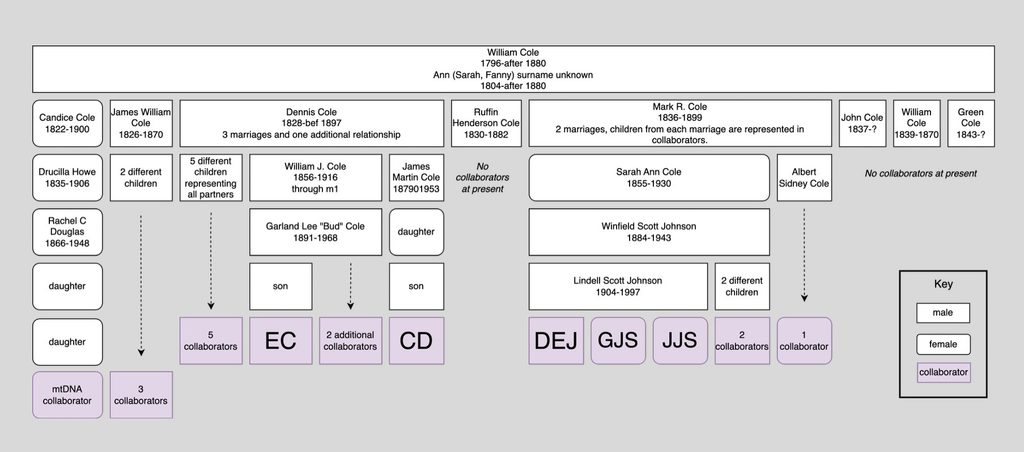
This blog entry focuses on the second goal, identifying the source of Indigenous DNA in descendants. First let’s tackle the question of direct line Indigenous Ancestry for William and Ann. The diagram below depicts the relationships of the current collaborators on the project, with the initials of the key collaborators shown. (Click to enlarge the images in this blog.)
YDNA and mtDNA Results for the Cole project

Quick reminder: YDNA traces the direct male line back through the generations and can also provide BGA information through specific haplogroups known to share the same migration pattern around or out of Africa. mtDNA does the same through the direct female line. For an overview of YDNA and mtDNA, see FamilyTreeDNA Y-DNA testing information and mtDNA testing information. Roberta Estes has written a comprehensive book on using FamilyTreeDNA.

We know that William Cole did not have Indigenous ancestry in his direct paternal line because EC, a Cole YDNA tester, does not have an Indigenous YDNA haplogroup (see EC in the diagram).

His wife Ann does not have Indigenous ancestry in her direct maternal line because a Cole descendant (labelled mtDNA collaborator on the diagram) does not have an mtDNA Indigenous haplogroup.

Future work may identify additional opportunities to use YDNA and mtDNA testing to identify the source of Indigenous DNA.

Comparison of 2026 Ancestral Region estimates with prior estimates

When Ancestry announced its update, I wondered how the results might have changed for the Cole project. Eighteen collaborators have shared their autosomal Ancestry DNA results with me. Five of the eighteen collaborators (initials shown on the figure above) had Indigenous American DNA prior to 2026. Much has changed with the update.

None of those without Indigenous DNA prior to 2026 now have it. Of those who had Indigenous ancestry prior to 2026:

  • DEJ (my uncle) continues to have 3 segments that were labelled Indigenous Americas – North prior to 2026 and are now labelled Indigenous Americas – Atlantic Northeast (Canada & US). This new label provides the opportunity to compare with DNA matches with more specificity than before. The 2026 segments are slightly smaller than before. There is an additional small segment (5.3 cM) that is also labelled Indigenous Americas – Atlantic Northeast. DEJ has Indigenous segments on Chromosomes 3, 4, 6, and 12.
  • JJS (my aunt) had Indigenous Americas – North on Chromsomes 3 and 6 in the same locations as my uncle DEJ in previous years. DEJ still has them but JJS now has none. JJS does have “unassigned” paternal segments in these locations. Ancestry knows JJS and DEJ are siblings. I’m not sure why Ancestry is unable to label JJS’s segments the same as DEJ. My interpretation is that the algorithms that determine relationships are not linked to the BGA algorithms that provide the labels.
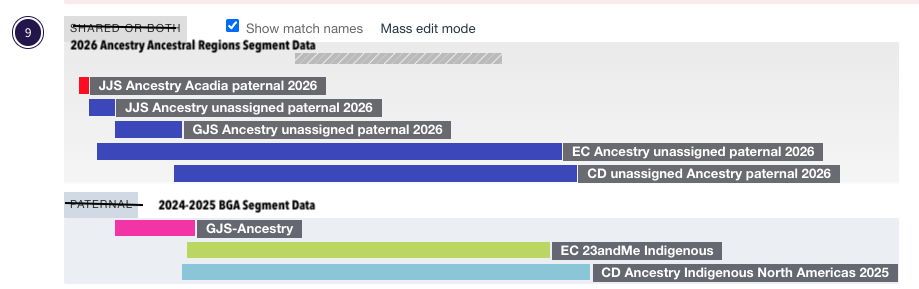
  • GJS (my mother) had an Indigenous Americas – North segment on the paternal (Cole) side of her tree on Chromosome 9 and now has none. It is now an “unassigned” paternal segment. Chromosome 3 continues to be a puzzle. On Chromosome 3, GJS has an area of overlap (8.7 cM, also visible on GEDmatch) with her two siblings DEJ and JJS. It is unassigned for GJS, but assigned Indigenous Americas – Atlantic Northeast for her sibling, DEJ. It seems like this segment could be assigned Indigenous for her as well as JJS.

  • EC is a fourth cousin of DEJ, JJS, and GJS, sharing the same ancestral couple, William and Ann Cole (refer to the diagram above for a descendancy diagram). EC had an Indigenous segment on Chromosome 9 from 23and Me in past years which is unassigned on Ancestry in 2026.
  • CD is also a fourth cousin of DEJ, JJS, and GJS, and is a third cousin of EC. In 2025, CD had a segment at Ancestry labelled Indigenous Americas – North on Chromosome 9 which was almost totally shared with EC. They also share this segment at MyHeritage. Again, this segment is now labelled unassigned for CD as well as EC.
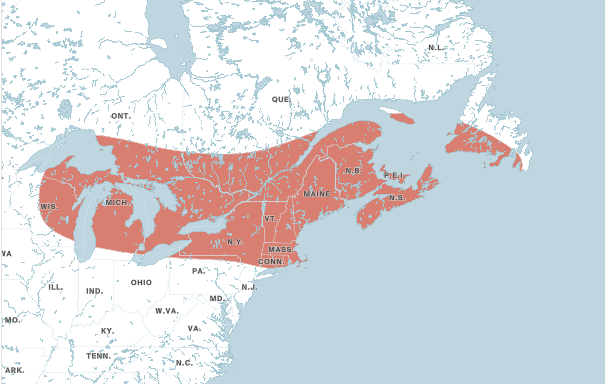
Ancestry’s next update will be interesting. Perhaps more of the unassigned segments will be assigned. It is challenging to build reference groups for the Indigenous Americas due to understandably reluctant participation from these communities. In 2026, Ancestry also initiated two new groups – Quebec and Acadia. I have not been able to find a good description of how these groups were determined and they are currently not listed as Indigenous Americas. Ancestry’s White Paper says the Ancestral Regions represent 1000 years ago. Leif Erikson may have landed in Newfoundland around 1000 C.E. but this time period should not represent European DNA in North America. Many of the Cole project kits I manage at Ancestry have small (1-3%) Quebec or Acadian. When looking at the maps provided at Ancestry, these regions overlap the Indigenous Americas – Atlantic Northeast (USA & Canada). I would love to know more about the science behind these three groups.
How might these segments help the Cole project?

I started by identifying Cole matches with Indigenous BGA segments. My next step is to identify which ancestors can be assigned to these segments by finding shared matches. Genetic genealogy is always paired with documentary research. Documentary research is being done simultaneously to learn as much as possible about William Cole and his FAN club. This may yield surnames of interest to watch for in trees of DNA matches. The DNA research can also be done the other way around: identify ancestral segments that can be assigned to William and Ann, and then see if those are noted to be of Indigenous Ancestry.

N.B.: It is a leap from the BGA segments to an ancestral couple! At this point in the project, I would be much happier if I had more triangulated segments from a wider variety of Cole descendants. Until more descendants are in the databases that share segment data, I am working with less data than I would like to. I need to be able to demonstrate that I have “walked the segments back” to the correct ancestors. (See an example at the end of this blog entry with my Davis and Ellis cousins.)

If cousins can be identified in the generation prior to William and Ann, it may be possible to further isolate the source of the Indigenous DNA. Research at MyHeritage identified an additional match to EC and CD on Chromosome 9, meaning we now have a triangulated group (three people matching the same segment). This match has a Mary Cole in their tree with no known parents. Mary Cole is about the same generation as William Cole and was reportedly born in South Carolina, the same birthplace as William’s wife Ann. It’s far too early to come to any conclusion about a relationship, but it is definitely intriguing. The Cole name could be wrong, Cole could be a coincidence, or the shared ancestry might not be a Cole since other lines of the match’s tree are incomplete. It’s time to complete the match’s tree back to the generation of Mary Cole and beyond.

I have an additional challenge with the Cole descendants. Many of them lived in Benton County, Tennessee from the early 1800s many remain there to this day. In one case, my mother and her siblings have one match with three known Benton County relationships – two are through the Cole family. I am concentrating on identifying matches who left Benton County and are not known to have secondary (or tertiary or more) relationships. With enough testers, it is more likely that ancestral segments can be identified correctly.

Documentary evidence of Indigenous ancestry will be hard to find. We may need to be content with isolating the branch through use of additional YDNA and mtDNA results.

This project may not be do-able right now due to lack of matches with segment data, lack of documentation, and lack of accurate BGA information. Only time will tell.

Jonny Perl has written an excellent blog about the update and his experience using Ancestral Region segments in a search for an ancestor.

Steps with links to additional resources

Step 1: Learn how to do chromosome painting at DNA Painter.

None of this would be possible without the amazing tools at DNA Painter. Jonny Perl continues to provide a service unmatched in the genetic genealogy community.

I am using the chromosome painting in a different way than its original intent: painting the DNA matches of one person. I am combining the results of the different testers with the BGA segments to look for patterns. This requires careful labelling at DNA Painter since the standard labels don’t fit (see diagrams above where I have crossed out and added text as new labels). It also requires meticulous attention to which side of the tree the ancestral segments are from to make sure that all the segments that are being painted could represent the right ancestral couple. Note: With the 2026 Ancestral Regions update, Ancestry has updated its SideView™ technology and corrected segments that were misassigned. See Yvonne’s article cited above for more information.

Step 2: Download Ancestral Region segment data.

Ancestry BGA segment data can be downloaded easily through a free tool provided by Borland Genetics.

Step 3: Create a shared BGA Chromosome painting for all collaborators.

Paint the segments you have downloaded into the same chromosome painting. See examples above. This is only one way to do this. If you have additional ideas, please get in touch!

Step 4: Identify Ancestral Segments

Use matches who have tested at MyHeritage, 23andMe, or FamilyTreeDNA, or who have transferred their DNA to GEDmatch to identify Ancestral Segments. In addition to Roberta Estes’ book (mentioned above), Jim Bartlett at Segmentology provides comprehensive information on using segments in genetic genealogy. Kitty Cooper and the excellent genealogy lectures at Legacy Family Tree webinars are other places to learn more about using segments.

Step 5: Analysis

Look carefully at start and stop points of segments and use the information to guide your conclusions. The above resources will also teach you about segment analysis. Refer to the genealogical proof standard to guide your analysis.

Step 6: Documentation.

I am using the WikiTree Blog and this blog to document my findings. A project is not complete until the results are recorded, even if they are inconclusive.

Happy researching!
Learning more about genealogy research

The internet continues to excel at what it was designed to do: Share information. For family history researchers, the free sharing of methods and resources has transformed a pastime that was once championed by the elite eager to prove descendancy from royalty to a hobby that proves we are one family.

I’ve compiled a list of free resources and learning opportunities for people who are just getting started or want to make sure their documentary genealogy research is on a firm foundation.

FamilySearch: FamilySearch is the largest database of free genealogy records and guidance on how to do genealogy. The FamilySearch Wiki is one of the first places I turn when starting a new project.

  • Research Resources: This part of the Wiki includes a section on Beginning Genealogy with a section on the research process, tips on choosing software, how to use the Wiki and research tools. There is more information on this page than any one genealogist knows.
  • Guided Research: This feature of the Wiki will walk you through how to research birth, marriage and death records in many localities around the world. Use the map to identify the locality you want and follow the links.
  • Main Wiki Page: From the main page, you can find the resources available for any locality, down to the county level in the US.

National Genealogical Society: This membership group has been around for over 100 years and publishes the National Genealogical Society Quarterly, the most prestigious genealogy publication. Recent diversity and inclusion efforts are encouraging.

African American Research: The continued efforts to share records related to African American history and the legacy of enslavement has meant more is possible than ever. Because of systematic attempts to hide the reality of slavery, records can be hard to find. African American research does require a great deal of persistence and unique approaches to discovering ancestors.

Legacy Family Tree Webinars presents genealogists talking about what they do best. Members have access to the full library of recordings, and many recordings are free for the first week.

  • Register here for free live webinars and check out other pre-recorded webinars on the same page.

Family History Research Companies all have free resources, often as a blog or as a series of videos. Taking the time to learn from their experts can make your research more efficient.

I set aside time every week to continue to learn more about family history research. I’m grateful there are free resources for researchers of all experience levels.

Research Like a Pro Week 5: Research Planning

Here is the latest instalment in my series about the Research Like a Pro process. I’m serving as a Peer Group Leader for this study group.

Our assignment this week was to plan our research phase, including:

  1. Summary of known facts based on our timeline
  2. Background information about the locality based on our locality guide
  3. Working hypothesis
  4. Identified sources
  5. Prioritized research strategy

During research planning, I discovered that I had not included everything I knew in the timeline phase. Since the James Stokers were often confused, I knew more about Edward Stoker, the father of a James Stoker, so I returned to my timeline and added information about Edward Stoker.

Writing up these sections forces the researcher to consider how they know what they know and what is needed to answer the research question. I’ve noticed that documenting middle name origins is particularly problematic. They seem to appear out of nowhere in authored sources. In a same-name project, they could be useful if records over time demonstrate consistent use. 

Writing a working hypothesis creates a tension between confirmation bias and keeping an open mind. It’s more likely that researchers do have a bias, so writing the hypothesis is one way to get it in the open. Since hypotheses are meant to be disproven, writing is the safest step for the researcher and a good reason to have peer review of finished products.

Prioritizing is valuable because it avoids the distractions that genealogical research so often inspires! I am not always certain of which sources will most efficiently answer my question and appreciate thinking that step through.

Research Like a Pro Week 2: Timeline and Citations

This is the second entry about my experience doing a research project while I serve as a peer group leader for the Research Like a Pro Study Group hosted by Diana Elder and Nicole Dyer of Family Locket.

Updating the Research Objective

With the assistance of my peers, I revised my research objective to be:

This project seeks to uniquely identify each James Stoker in Bourbon County, Kentucky from approximately 1820 to 1880. 

  • James Stoker filed a bond to marry Polly Ross on 9 December 1822 in Bourbon County.
  • Jas. Stoker, age 79, lived in the household of his son-in-law, Silas. Cleaver, in 1880 in Millersburg, Bourbon County. 
  • James H. Stoker, presumed age 40-50, lived in Bourbon County in 1830.

The task this week was two-fold: create a timeline of known facts and to cite them properly.

Timeline

Creating a timeline involves taking everything already known about the research topic and arranging it in order. This provides an opportunity to see new patterns and identify gaps in the research. I am using Airtable to organize my research.

I entered the documents I had about the various James Stokers into the timeline tab in Airtable. My timeline has the following fields (columns): Event, Stoker as named in record, Stoker sorting tests (more on this later), Date (text field YYYY-MM-DD with as much information as is known), Place (Single-select field type written State, County, Town using 2 letter state abbreviations), Type (of event, another single-select field with choices like birth, census, death), URL (to the source document), Source citation (yes, the entire citation. This is the master location for the citation), Details (an abstract of the information in the source), FANS (link to the FAN Club table), Notes (thoughts about the source).\

I included all the known events for my ancestor James Stoker since I had eight census records for him (two are state censuses). I have a birth state, birth date calculated from his cemetery marker, marriage date and place, death and cemetery information.

Since this is a project to distinguish different people of the same/similar name, I am testing using two columns for name, one as it appears in the record, and the second column to try different ways to sort the James Stokers. Place and time will guide the sorting.

Citations

Complete source citations form the foundation for genealogical analysis. Fortunately, I formed good habits citing my sources starting in 1998 when I was enrolled in the certificate program in Family History and Genealogy at the University of Washington. Citations weren’t as exacting then as they are now. Citation is also required in my other field, health care, and I worked in research for several years and co-authored scientific publications. Transitioning to the professional genealogist role meant switching to humanities-style citations and meeting genealogical standards. I frequently refer to the Chicago Manual of Style to manage the mechanics of humanities writing and citations. I refer to Elizabeth Shown Mill’s comprehensive book, Evidence Explained, and Thomas Jones’ Mastering Genealogical Documentation as needed.

Using a template for genealogical citations made it easier for me to meet the genealogical standards. I have an Airtable Citation Guide accessible from my bookmarks bar. It is based on the Research Like a Pro templates. The fields in my base are Name (type of source, like Birth Certificate Original, FindAGrave, Pension File), Category (birth, cemetery, military, for example), template (see example below), Citation Example (a completed citation of that type), Short Form (when citing the source multiple times.) I tend to put more in citations than others (like complete dates instead of just years and complete stable URLs) because I can always shorten the citation if needed.

Here is an example of a template for FindAGrave:

Find A Grave, database and images ([Stable URL] : accessed [DD Month YYYY]), memorial [NNNNN], [Name As Appears], ([BBBB-DDDD]), gravestone photographed by [Contributor], citing [Name of Cemetery, Town, County, State].

And the 1921 Canadian Census at Library and Archives Canada:

1921 Census, [Province], [name] District [#], Enumeration Sub-district [#], page [#], dwelling [#], household [#], [Name as Written]; database with images Library and Archives Canada ([stable URL] : accessed [DD Month YYYY]); citing LAC microfilm [#].

Creating the timeline and the source citations supports the next part of the research process, analyzing the evidence.

Research Like a Pro Week 1: Getting started and the Research Objective

This fall I am volunteering as a Peer Group Leader for the Research Like a Pro Study Group hosted by Diana Elder and Nicole Dyer of Family Locket. Making the transition from family historian to professional genealogist required me to become a more disciplined researcher. The team at Family Locket supported me on my journey through their podcast, books, courses, and presentations at conferences. I’m a process person likely due to my background in quality improvement. Throughout my healthcare career, the Model for Improvement guided our efforts with the message “Every system is perfectly designed to get the results it gets.” (Paul Batalden, often quoted by Don Berwick). To improve as a genealogist, I needed to change my system. In this case, that’s the research process. For the next ten weeks, I will share my insights into the Research Like a Pro process. This course is focusing on documentary research. As a peer group leader, I will be completing a project with the participants. It’s a great opportunity to work on my own family history.

Pedigree Analysis

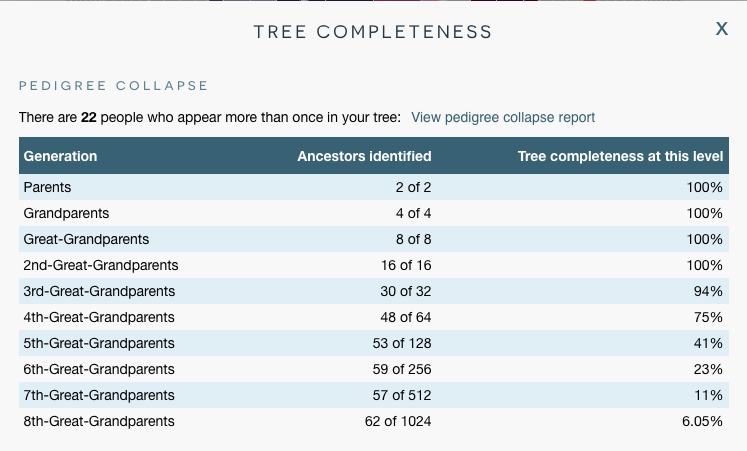
Identifying potential areas for research is the first step in making the most of your research efforts. Analyzing your pedigree accomplishes this step. DNA Painter provides multiple ways to visualize your family tree. The first thing I checked was my tree completeness. This tells me where I have gaps in my tree and also reminds me about pedigree collapse, which is a subject for a different blog.

Tree Completeness Report from DNA Painter

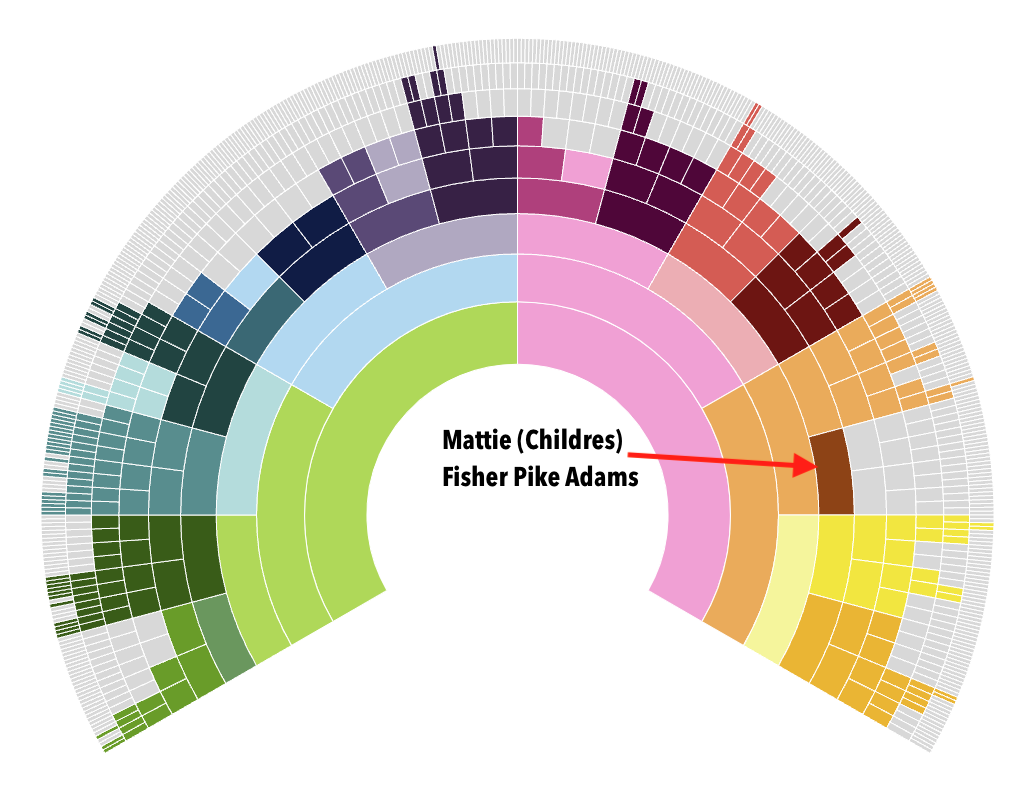
I’m missing two 3x-great grandparents and sixteen 4x-great grandparents. A fan chart, like this example from DNA Painter is another way to look at the gaps. On DNA painter, hovering over each colored shape brings up the name of the person represented in that space on the chart. That feature isn’t shown in the image below since I can’t capture the hovering. You can use this link to see it for yourself. My father’s side of the family is on the left and my mother on the right. I’ve coordinated these colours to resemble the coloured dots I use on Ancestry to mark my DNA matches.

FAN Chart from DNA Painter Showing Location of Mattie (Childres) Fisher Pike Adams

The arrow indicates the location of the most recent ancestor whose parents I don’t know. Many refer to this as a “Brick Wall.” I could continue documentary research on Mattie for this course. During the Research Like a Pro with DNA e-course I completed, I identified several families that could be Mattie’s parents.

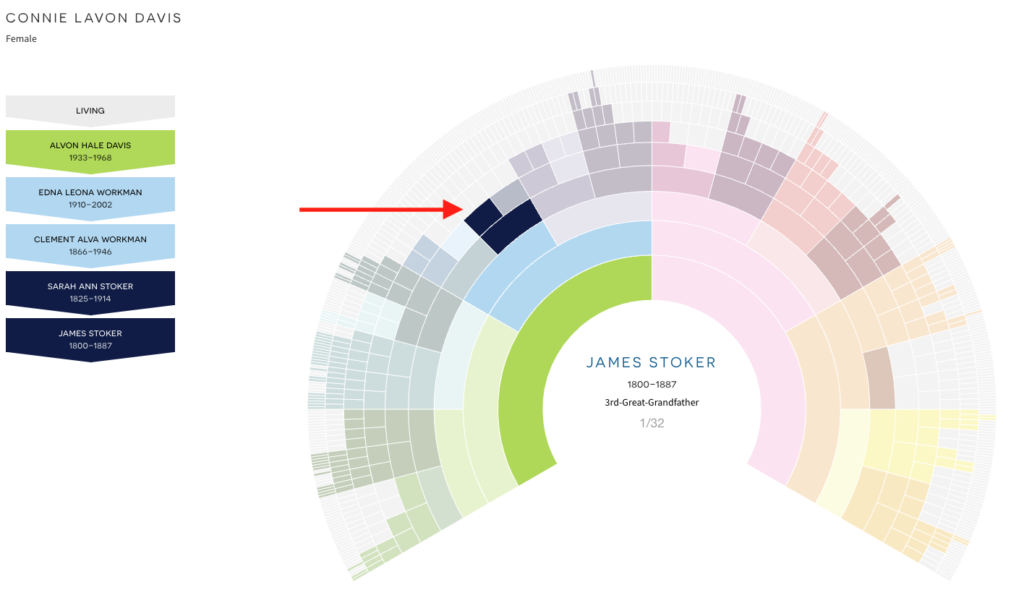
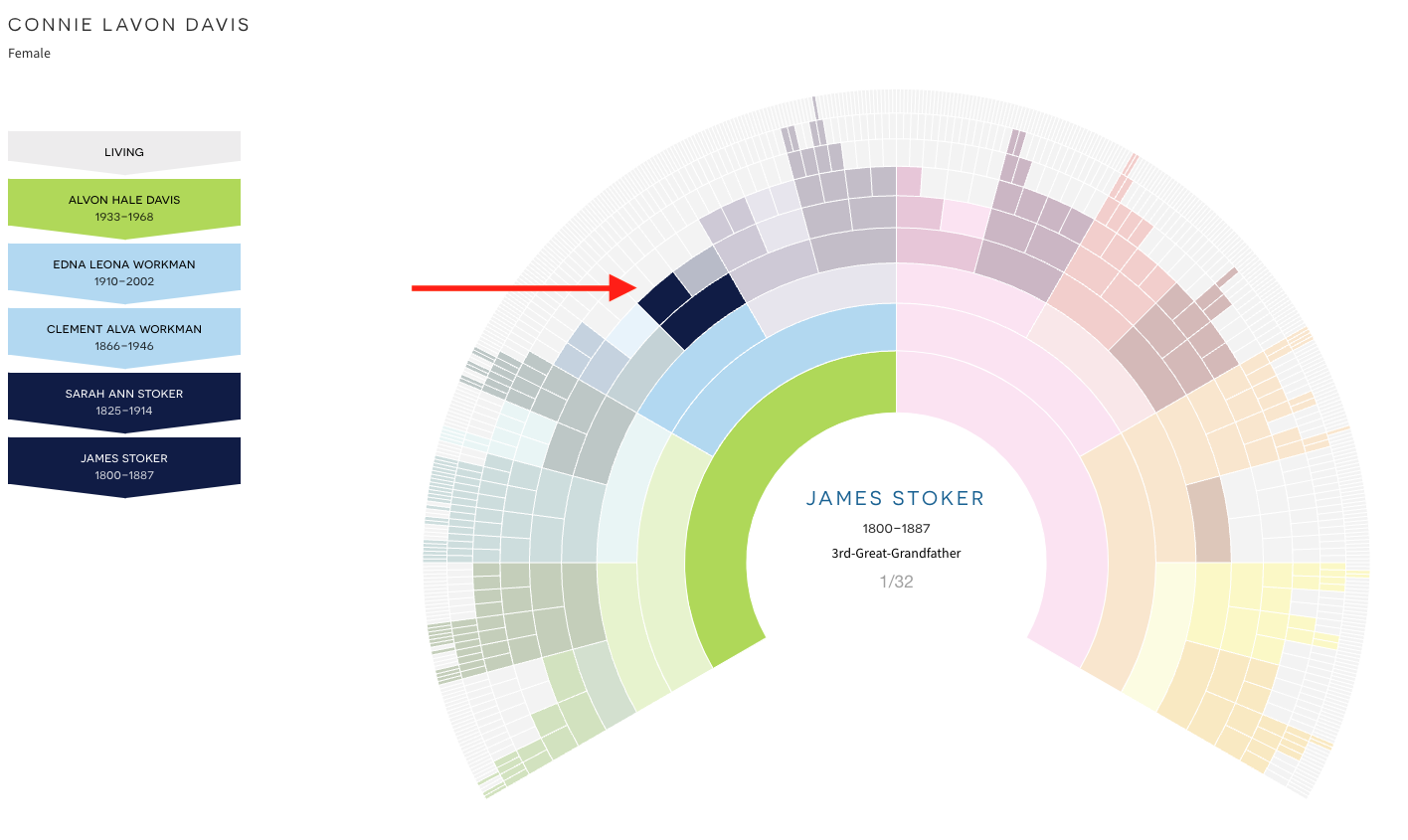
Another opportunity is my 3x-great grandfather, James Stoker, shown below.

James Stoker in DNA Painter Fan Chart

My grandmother believed he was the son of Edward Stoker, a Revolutionary War Veteran. During ProGen 46, I took a look at the link between generations from Edward Stoker to my 3x-great grandfather James and realized there were multiple men named James Stoker who could have been his son James, as noted in a Stoker family Bible. Several of them left records in Bourbon County, Kentucky around 1820 where my ancestor James Stoker married Polly Ross on 9 December 1822. I also noted that the birth date of James Stoker in the family Bible of Edward Stoker (found in his Revolutionary War Pension file) did not match the birthdate of my 3x-great grandfather. Many family trees shared on Ancestry confuse the James Stokers, and the Ancestry hinting algorithm points to Edward Stoker. WikiTree has my James Stoker linked to Edward. The FamilySearch Family Tree has a note about the confusion: ” Be aware…. Another Individual, ‘James T Stoker’ was born in Kentucky and resided most of his live [sic] in Nicholas County, KY. Married Sytha Ann McDonald 20 Dec 1827 in Nicholas Co KY.” I didn’t fully analyze the same-name people when I first discovered the confusion. Thoroughly researching the men and writing up the results would be a contribution and help me correct the WikiTree entry.

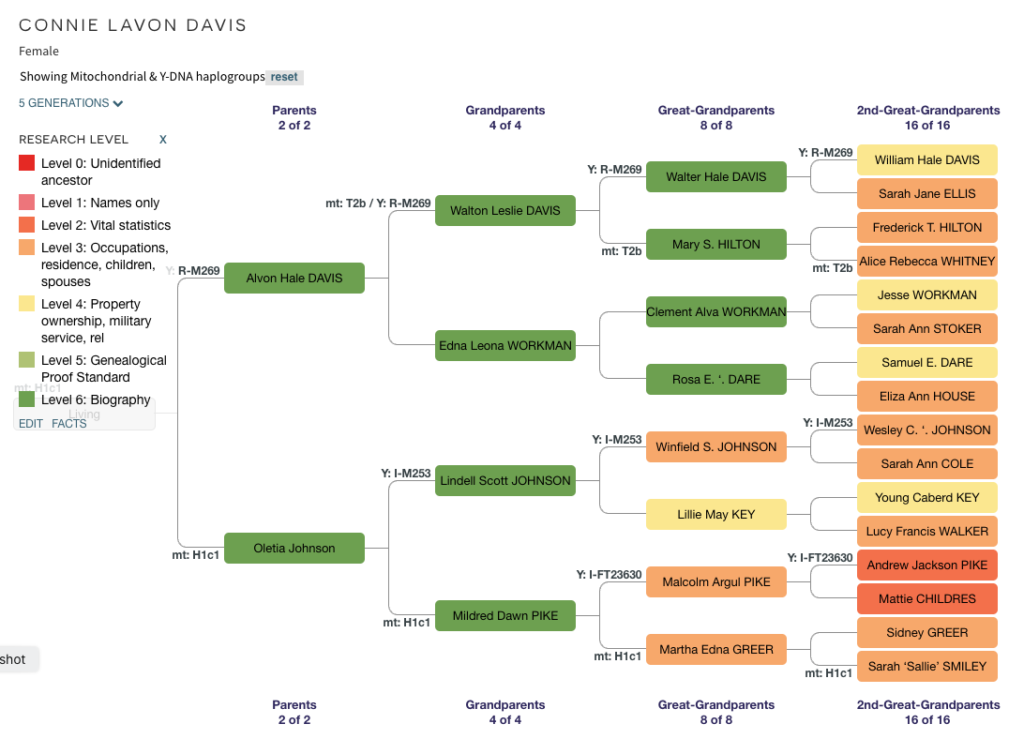
Another way of analyzing my pedigree and determining where I could focus is using Yvette Hoitink’s Level Up Challenge. I started working on improving my genealogy based on her approach after she published this idea in her blog in January of 2021. The levels describe the completeness of your research for each ancestor. In some cases I’m not sure which level to give because I write a biography for everyone on WikiTree. I may not have researched all property records (some parts of my family were very mobile) or know every church denomination they attended over time. I used DNA Painter’s Dimensions “Research Level” feature to create this chart.

Research Level at DNA Painter

Based on this diagram, my efforts would be to continue researching my mother’s family, particularly Andrew Jackson Pike and Mattie Childres that I designated as Level 2. (Note: See the YDNA and mtDNA haplogroups? That’s a neat feature of the tree on DNA Painter, and another project is to complete my YDNA and mtDNA tree like Roberta Estes does). I spend a lot of time researching my mother’s family and have neglected my paternal grandmother’s family including James Stoker.

I haven’t written up a same-name case before, so that’s my choice for this project. I expect that writing clearly will be the biggest challenge. For reference, I have two National Genealogical Society (NGSQ) articles I reviewed during my NGSQ Study Group. One is by Shannon Green, who was my mentor in ProGen 46. The other is by Allen R. Peterson and Stephen J. Allen. Both are found in the December 2019 NGSQ

File Organization

Our assignment this week also asks us to describe how we name and organize files and how our choices support our research.

I organize documents in two ways depending on where I am in the research process. My basic family history files structure relies on folders for the surnames of each of my sixteen 2x-great grandparents. Within those folders there are sub-folders for individuals. Women are filed under their maiden name, since it is the only constant. While I am working on a specific project, I create a project folder within the surname or person. Project folders start with a number like 01-Mattie Childres Father so that it will sort at the top. Within each project folder, there is a sources folder.

I use the following naming conventions for files (.jpg, .pdf, .docx, etc.) so that the folder becomes a timeline:

YYYY-MM-DD_LASTNAME_Firstname_Middleifpresent_STATE_County_Town_type.file

  • Dates: YYYY-MM-DD format keeps them sorted. I include as much detail as I have. It could be year only, year and month, or all three. If I don’t have the exact date, I use the best information I have and put “ca” after the date so I know it is approximate and the sorting order is maintained.
  • Names are written as they appear in the record with the surname in ALL CAPS. The caps help me scan the files for surnames and variations.
  • State is the two-digit state or province abbreviation.
  • Type is the type of document
  • File is the extension (pdf, jpg, docx).

Examples:

1840_STOKER_Jas_KY_Bourbon_census.jpg

1882-11_SMILEY_James_KY_Floyd_court.jpg

1955ca_DAVIS_Alvon_AK_Kodiak_letter_to_DAVIS_Edna_transcription.docx

When I complete a project or identify a document I know I want to cite in Reunion (family tree software for Mac) I make a duplicate and add the source number that Reunion assigns to the beginning of the name and file it in a a digital folder in my Reunion folder.

Filed in Reunion:

2622-1882_11_SMILEY_James_KY_Floyd_court.jpg

I keep any useful paper copies in plastic sleeves in 3 ring binders in numeric order of the Reunion citation. I should invest in some archival safe plastic sleeves for the few originals that I own.

Research Objective

A possible research objective is:

The goal of this project is to identify which of multiple James Stokers known to have been in Kentucky was the son of Edward Stoker. Edward Stoker served in Capt. John Lemon’s Company during the Revolutionary War and died 7 May 1846 in Nicholas County, Kentucky.

Another option is:

The goal of this research project is to clarify the identities of men named James Stoker in Bourbon County, Kentucky from approximately 1820 to 1840. James Stoker filed a bond to marry Polly Ross on 9 December 1822 in Bourbon County. Jas. Stoker, age 79, lived in the household of his son-in-law, Jas. Cleaver, in 1880 in Millersburg, Bourbon County. James H. Stoker, presumed age 40-50, lived in Bourbon County in 1830.

I have additional information about the men named James Stoker in Kentucky but I think it would confuse the objective. I can put it in the next section of my research project document, summary of known facts. The objective identifies Edward Stoker, because I realize he is the person I can identify at present. I look forward to receiving feedback from my coursemates!